Before You File Bankruptcy: Most People Skip the Step That Actually Solves the Problem
There’s a moment a lot of people quietly hit. Not the dramatic kind. No courtroom. No headline moment.
Just a Tuesday night, staring at bills and thinking:
“I might need to file bankruptcy.”
And honestly, that thought usually shows up after things have already felt overwhelming for a while.
Credit cards are maxed. Payments are late. Stress is constant. And bankruptcy starts to sound less like a legal process and more like the only exit left in a room that feels like it’s closing in.
But here’s something most people are never told clearly enough:
Most financial situations that feel like bankruptcy situations are actually cash flow problems that haven’t been fully worked through yet. That distinction changes everything.
Before making any major decision, there are three questions worth asking first. Most people never get to them.
The Hidden Step Most People Skip
When people hit financial stress, they usually jump straight to the biggest possible solution:
- Bankruptcy
- Debt consolidation
- Selling everything
- Giving up
But there’s a step that almost always comes before those options.
Cash flow recovery.
Not budgeting in the “cut every coffee and cancel every subscription” sense.
Actual recovery:
- Stabilizing income
- Reducing unnecessary leaks
- Negotiating down payments and interest
- Finding overlooked benefits
- Restructuring debt so it stops growing faster than income
Here’s the simple principle that guides this entire approach:
Focus first on cash-flow recovery. When cash flow is stabilized or moving positive, many financial problems become solvable over time.
That one shift is often the difference between panic decisions and structured recovery.
Here’s what that can look like in practice:
Medical Bills
A $12,000 emergency room bill is not necessarily a $12,000 problem. Most hospitals have financial assistance programs that are never mentioned at discharge. Many will reduce or forgive balances entirely for households under a certain income threshold. Almost all will negotiate a payment plan with zero interest if asked directly. The bill that arrives in the mail is a starting point, not a final number.
That one conversation doesn’t solve everything. But it changes the math. And when the math changes, the options change.
Collections
When there are three or four unsecured debts in collections simultaneously, it can feel like the walls are closing in from every direction. But creditors in collections have already written down the value of that debt. Many will settle for 40 to 60 cents on the dollar, especially if a lump sum is possible. A $9,000 balance that has been in collections for a year might close for $4,500. That is not a loophole. That is how the system actually works.
Again, that one negotiation doesn’t solve everything. But it changes the math. And when the math changes, the options change.
Credit Cards
Most people think of a credit card as the problem. But a credit card with available limit can also function as a cash flow tool.
Here is how it works in practice. Say someone brings home $4,000 a month. Instead of depositing that paycheck into a checking account and paying bills from there, they route the paycheck directly onto the credit card balance. Then they pay their monthly expenses from the card throughout the month. As long as they spend less than they make, the balance comes down. No separate minimum payment required. The deposit is the payment. Unlike a personal loan with a fixed monthly obligation, a credit card is a revolving line — every dollar deposited reduces the balance immediately, which reduces the interest accruing against it.
The reason this works is how interest is calculated. Most credit cards charge interest based on the average daily balance, not the statement balance. When a large payment hits early in the billing cycle, the average daily balance drops significantly, which means interest charges drop significantly, even if the full balance isn’t cleared.
Over time, more of every payment goes toward principal. Balances fall faster than they would with minimum payments. Credit utilization improves as balances drop, which moves the credit score. And the monthly cash that was disappearing into interest starts becoming available for other things.
Yes, it requires discipline and it requires available credit. But for someone who has both, it can compress what might have been a five year debt payoff into two years or less, without consolidation loans, without bankruptcy, and without surrendering control of the process to a third party.
That is not a loophole. That is cash flow working in your direction instead of against it.
Why Bankruptcy Feels Like the Obvious Answer
When debt builds up, it doesn’t feel mathematical. It feels emotional. It’s important to separate the emotions from the math.
Collection calls don’t care about spreadsheets. Late notices don’t ask about your future earning potential. And credit scores drop faster than most people can emotionally process.
So the brain does something very human: It looks for a reset button. Bankruptcy looks like that button.
But here’s the catch: bankruptcy solves debt structure. It does not automatically solve cash flow.
If income is stable, there is often another path forward that doesn’t require a legal reset of your financial life.
The Part Nobody Explains Well Enough
Debt is not just a number problem. It’s a time problem.
If income is rising or can be stabilized, debt often becomes more manageable over time because:
- payments become smaller relative to income
- interest burdens can be reduced or negotiated
- some debts can be settled or restructured
- financial breathing room increases
This is why two people with the same debt can have completely different outcomes.
One is in recovery. The other is in breakdown. The difference is almost never the debt itself.
It’s cash flow.
The Three Questions That Matter More Than Debt Size
Before jumping to bankruptcy, a more useful set of questions is:
1. Can cash flow be stabilized within the next 30 to 90 days?
This is the most important question because it determines whether time is an asset or a liability. If income is coming in and expenses can be reduced or deferred even temporarily, the situation is not static. It is moving. And a situation that is moving in the right direction, even slowly, is fundamentally different from one that is not. Most options stay open when cash flow is stabilizing. Most options close when it isn’t.
2. Can income be increased within 6 to 12 months?
It doesn’t have to be dramatic. An extra $300 to $500 a month changes the math on most household debt situations. A part time shift, a freelance project, a skill that hasn’t been monetized yet. The question isn’t whether a six figure raise is coming. The question is whether income is fixed or whether there is any room to move it. Because even small movement compounding over 12 months can be the difference between a debt that is shrinking and one that isn’t.
3. Are there resources, programs, or restructuring options not yet used?
Most people in financial crisis assume they have already exhausted their options. Most haven’t. Hardship programs, payment reductions, benefits eligibility, refinancing options, interest rate negotiations — these exist specifically for people in difficult situations and they are systematically underused. Not because people are lazy. If we knew better, we’d do better.
What Bankruptcy Actually Costs
This is not a scare tactic. This is what the process looks like on the ground.
At the time of this writing, filing Chapter 7 bankruptcy costs between $1,500 and $4,000. Chapter 13 runs $2,500 to $6,000. That is money paid to exit a situation that, in many cases, could have funded the way out of it instead. But that’s not the only cost.
Your credit score drops 130 to 200 points immediately. Chapter 7 stays on your credit report for 10 years. Chapter 13 stays for 7. During that window, any credit you can get comes with the highest interest rates allowed by law. Mortgages, car loans, and personal loans are often flatly denied for years.
In a Chapter 7 filing, a court-appointed trustee can seize and sell property that isn’t legally exempt, including jewelry, collections, a second vehicle, home equity above your state’s threshold. In Chapter 13, every dollar of discretionary income goes to a court trustee for 3 to 5 years. You do not control that money.
Landlords run credit checks. Many will reject you. Employers in finance, management, and roles involving sensitive data can and do run credit checks. A bankruptcy on record can cost you the job before you get to the interview. Utility companies may require large upfront deposits before turning on your service.
Your entire financial history — income, spending, assets — becomes a permanent public record.
And bankruptcy does not erase everything. Child support, alimony, most student loans, recent tax debts, court fines, and debts from fraudulent activity survive the filing. You still owe them on the other side.
If anyone co-signed a loan for you, your filing does not protect them. Creditors will pursue them for the full balance.
Now you know what the reset button costs.
Where Bankruptcy Actually Fits
Bankruptcy is not “good” or “bad.” It is a legal tool designed for specific situations where recovery is not realistically achievable.
It tends to make sense when:
- income is insufficient long-term
- debt load is structurally unpayable
- cash flow cannot be stabilized even after adjustments
- other options have been exhausted
But it should usually be evaluated after recovery options, not before them. Not because bankruptcy is wrong. But because it is irreversible in practical impact for many years.
A Different Way to Think About Financial Stress
Most people assume:
“My debt is the problem.”
But in many cases, the more accurate statement is:
“My cash flow is under-optimized.”
That sounds less dramatic. But it’s actually more solvable. And solvable temporary problems don’t require permanent solutions.
The Better First Move
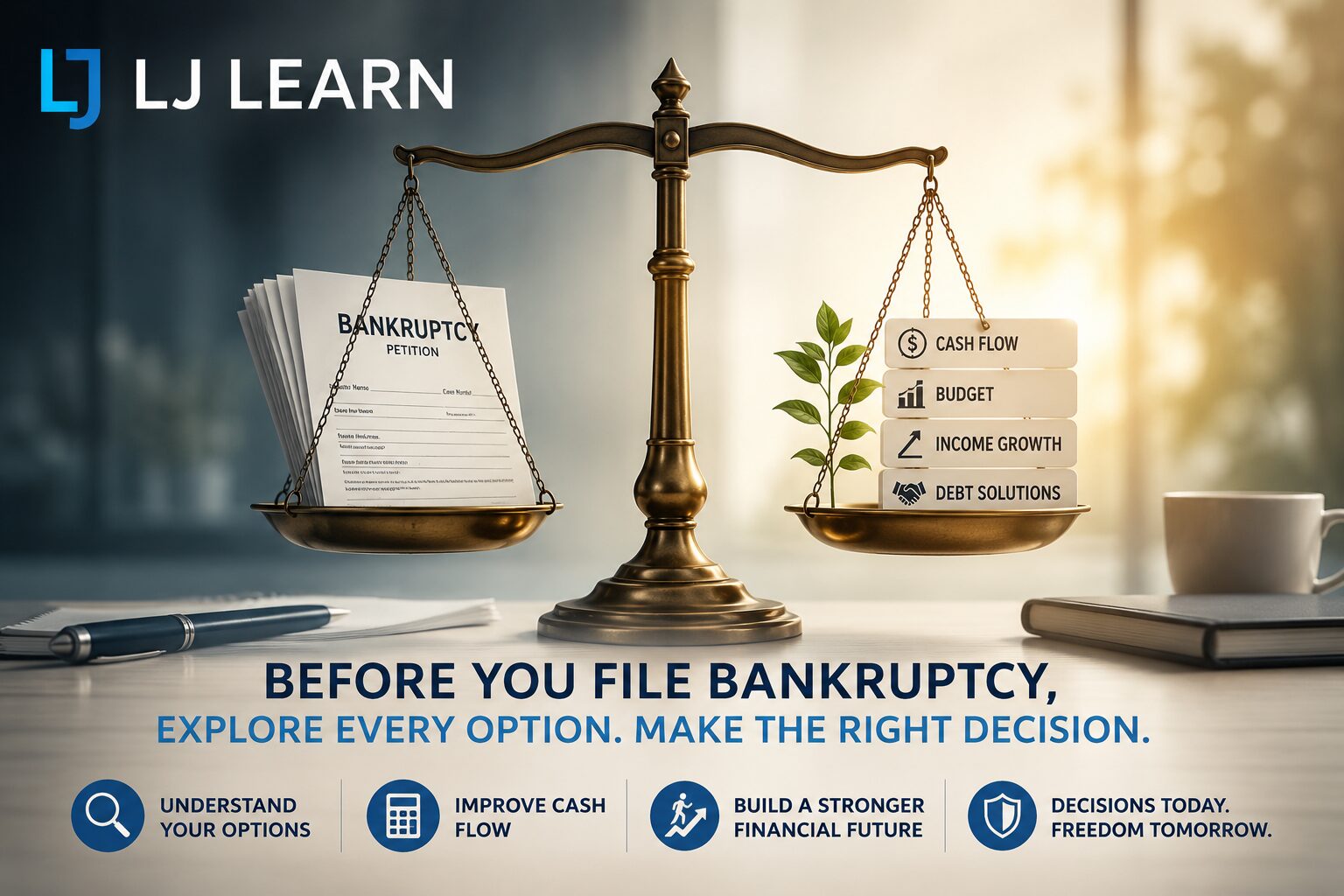
Before making any major decision about bankruptcy, consolidation, or surrendering financial control, start with a simple process:
- stabilize cash flow
- identify money leaks
- explore assistance and relief programs
- evaluate income opportunities
- restructure debt strategically
Only after that picture is clear does it make sense to consider irreversible legal options.
Because once cash flow is moving in the right direction, many situations that once felt impossible start to look manageable again.
Not easy.
But manageable.
And that difference matters.
Before You Call a Bankruptcy Attorney
Before calling a bankruptcy attorney or a debt consolidation hotline, talk to a financial coach. Not someone selling a product. Not a toll free number staffed by someone reading from a script. Someone who will actually look at your full picture — income, expenses, debt structure, available options — and help you build a sequence that makes sense for your situation. That conversation costs far less than a bankruptcy filing and often surfaces options that never come up in a crisis call center. If you are not sure where to start, the recovery resources directory at LJLearn.com/recover is a good first stop. It exists specifically for moments like this one.
Final Thought
Financial pressure makes everything feel urgent. But urgency is not the same as clarity.
The goal is not to avoid bankruptcy at all costs, but to make sure that if you ever choose it, you do so from a position of full understanding, not financial exhaustion.
And in many cases, once cash flow is stabilized, people discover something surprising:
They don’t actually need the reset. They just needed a path forward.
Thanks for Reading!
Looking for more insights, exclusive offers, and expert tips? Stay connected with the LJ Learn newsletter! Join our community of curious minds and passionate learners to continue your lifelong learning journey.