Financial Documentation Checklist for Crisis and Disaster
When a crisis hits, paperwork is the last thing on your mind. But in the hours and days that follow, the right documents determine how quickly you can access emergency assistance, file an insurance claim, prove your identity, and begin rebuilding. Delays in recovery are often not caused by a lack of resources but by a lack of documentation to unlock them.
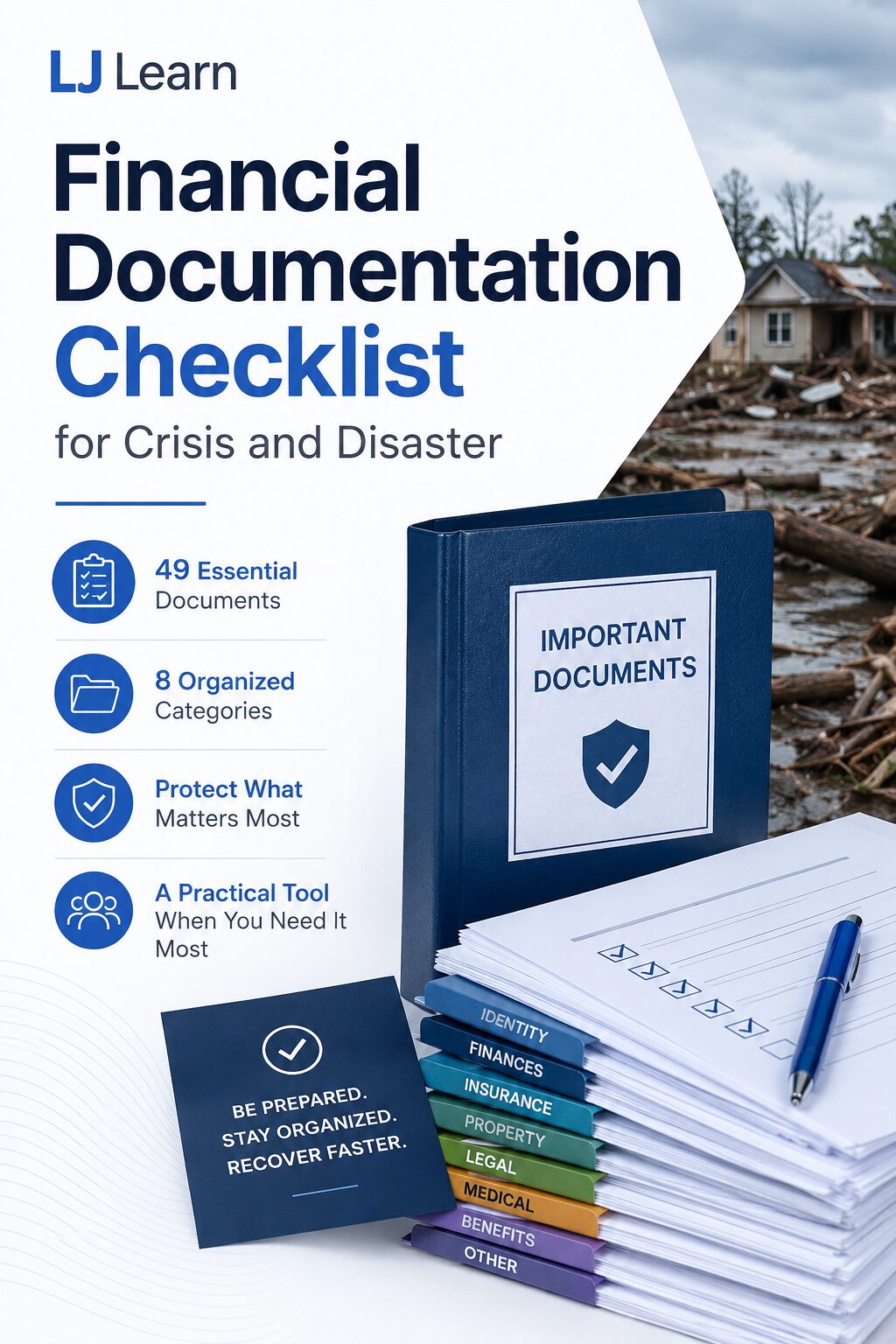
This checklist covers 49 essential financial and legal documents organized into eight categories. Whether you are dealing with a natural disaster, a sudden housing loss, a family emergency, or any other crisis that disrupts your financial stability, these are the records that agencies, insurers, lenders, and courts will ask for first.
You do not need everything on this list to get started. Work through the Immediate Priority section first. Those six items will get you through most intake processes, shelter registrations, and emergency medical situations. Then work through the remaining categories as your situation allows.
If you are helping someone else navigate a crisis, whether as a case manager, a family member, or a community advocate, this list is designed to be used as a working tool. Check off what has been secured, identify what is missing, and use the notes under each item to understand why it matters and where to focus your efforts.
Some of these documents can be replaced. Others take time. Knowing which is which can make a significant difference in how quickly someone stabilizes after a loss.
Immediate Priority
Government-issued photo ID — driver’s license, passport, or state ID Social Security cards — for yourself and any dependents
Birth certificates — original or certified copies
Health insurance cards — medical, dental, vision, front and back
Prescription medication list — names, dosages, prescribing doctor, pharmacy
Cash on hand in small bills — ATMs and card systems may be down
Housing and Property
Mortgage or lease agreement — proves residence and ownership rights
Homeowner’s or renter’s insurance policy — carrier name, policy number, claims phone
Property tax records — most recent statement
Vehicle title and registration — one document per vehicle
Vehicle insurance cards — keep one copy in each vehicle
Deed or land survey — if you own land or real property
HOA documents — contact info and any emergency procedures
Banking and Finances
Bank account numbers — routing and account numbers for checking and savings
Recent bank statements — last two to three months for all accounts
Credit and debit cards — keep a separate list of numbers and issuer hotlines
Investment and retirement account info — 401k, IRA, brokerage account numbers and custodian contact
Loan and debt records — auto, student, personal; lender, balance, and payment info
Safe deposit box key and location — note which branch and what is inside
Income and Employment
Recent pay stubs — last two to three for each household earner0
Last two years of tax returns — federal and state, 1040 and all schedules W-2s and 1099s — matched to the tax years above
Employment contract or offer letter — shows salary, benefits, and employer contact
Business records — if self-employed: EIN, business license, last two years of profit and loss
Unemployment or benefits documentation — if applicable, award letters and payment info
Insurance Policies
Life insurance policies — policy number, insurer, death benefit, beneficiaries
Disability insurance — short-term and long-term if separate
Flood or earthquake insurance — if separate from homeowner’s, verify coverage limits
Umbrella policy — carrier, policy number, coverage amount
FEMA flood map classification — helpful for disaster assistance claims
Family and Legal
Marriage or divorce decree — certified copy from the issuing county
Child custody order — if applicable, certified copy
Will and trust documents — location of originals and name of attorney
Power of attorney — financial and medical, if established
Advanced healthcare directive or living will — also known as a DNR or medical POA
Adoption or guardianship paperwork — if applicable
Military discharge papers DD-214 — veterans need this for benefits access
Digital Backup Essentials
Encrypted cloud backup of all documents — Google Drive, iCloud, or password-protected storage
Password manager or written emergency password list — stored separately from devices
Photos or video walkthrough of home contents — for insurance purposes, stored offsite or in cloud
Contact list saved offline — doctor, attorney, insurance agents, family, employer
Copies stored with a trusted person — out-of-state family member or attorney preferred
Disaster Assistance
FEMA registration number — if already applied, keep this in writing
Disaster declaration number — your county’s official FEMA DR number
Contractor estimates and receipts — for any emergency repairs already made
Photos of damage with timestamps — date and time metadata is critical for claims
Correspondence with insurers and agencies — keep every letter, email, and claim number
Red Cross or shelter registration records — if you used emergency shelter, keep proof
Thanks for Reading!
Looking for more insights, exclusive offers, and expert tips? Stay connected with the LJ Learn newsletter! Join our community of curious minds and passionate learners to continue your lifelong learning journey.