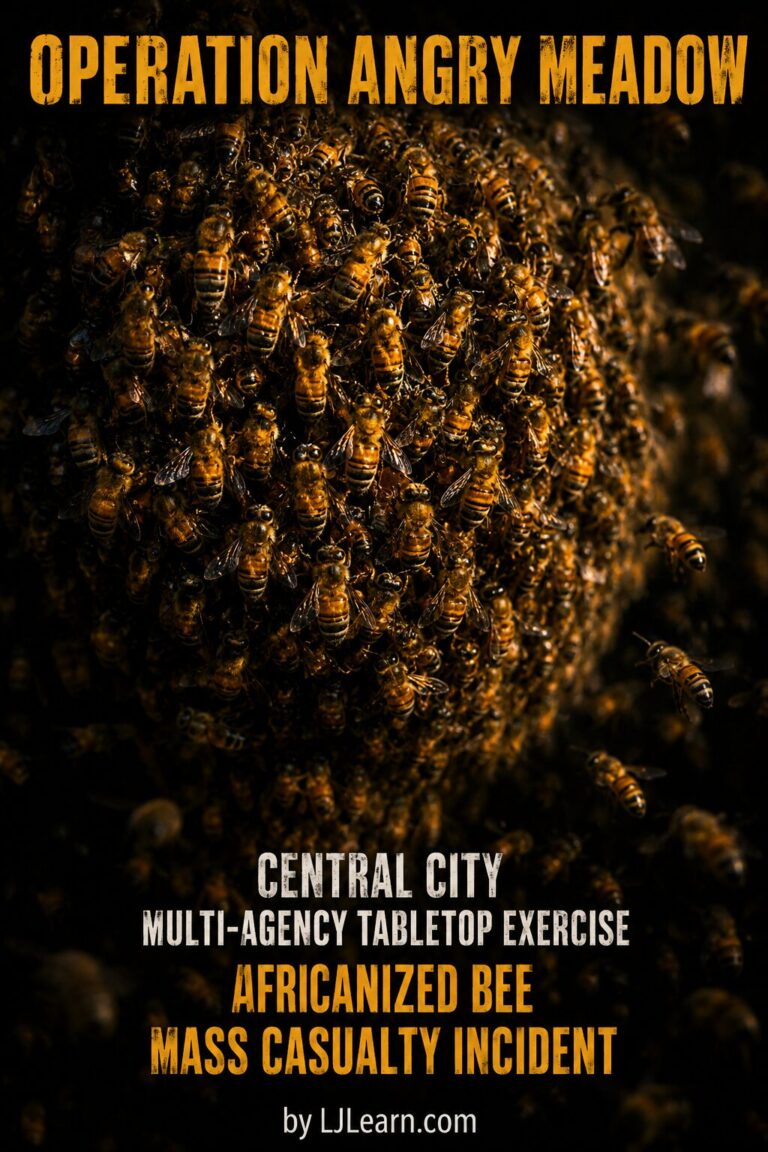
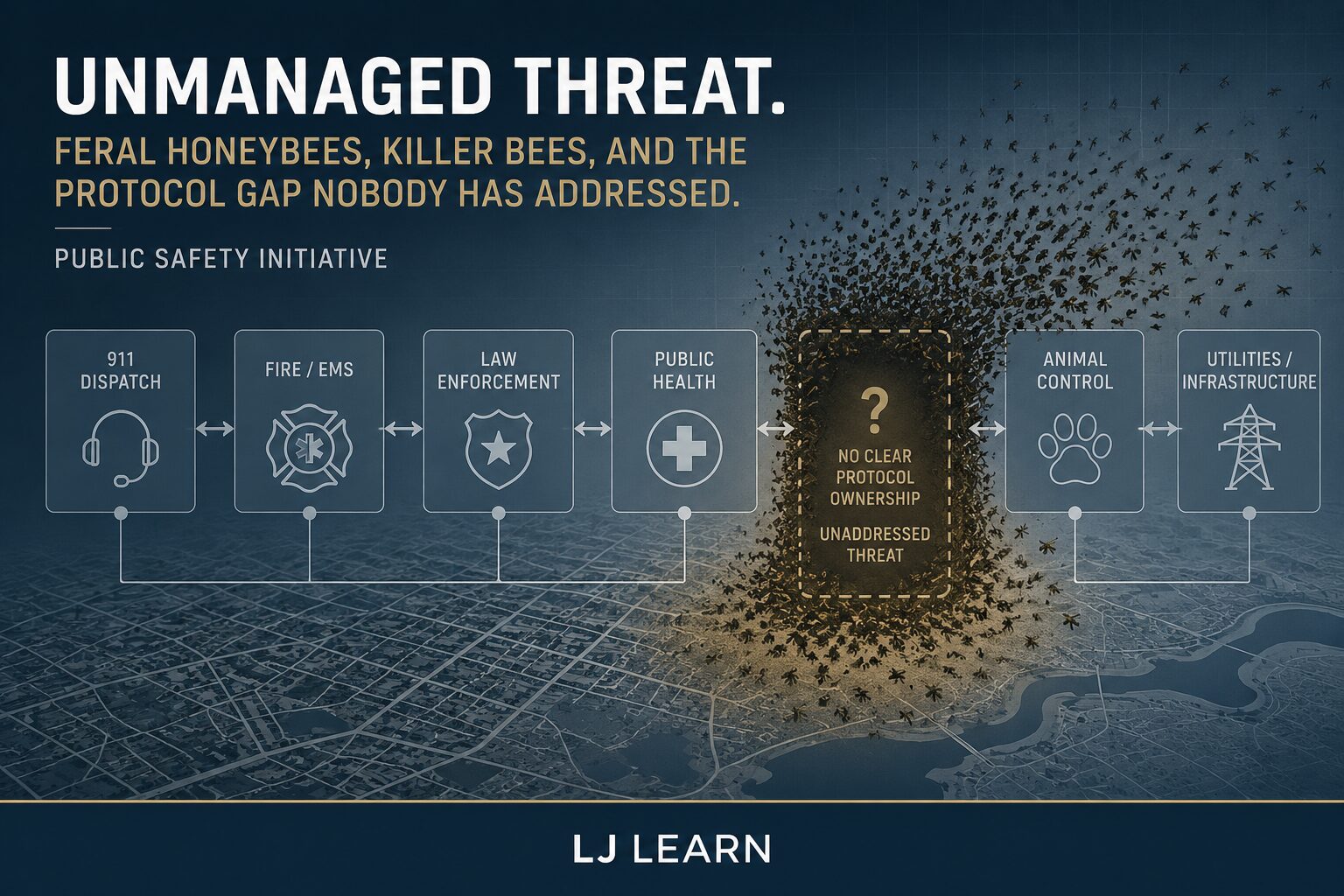
Unmanaged Threat: Feral Honeybees, Killer Bees, and the Protocol Gap Nobody Has Addressed – Public Safety Initiative
A first responder and policy brief identifying critical gaps in mass casualty preparedness, regulatory framework, and legal accountability for feral Africanized and European honeybee swarm incidents in North America.
Classification: Public Interest, For Open Distribution
Executive Summary
Feral Africanized honeybee swarm attacks represent a documented, recurring, and foreseeable mass casualty threat in North America for which no standardized first responder protocol exists, no regulatory framework governs source accountability, and no forensic evidence preservation procedure has been established.
The Government of Canada ranks the Africanized honeybee #2 on its most dangerous insects list, between the brown recluse and the black widow spider. It has killed approximately 1,000 people across the Americas. It is established across the American Southwest and moving north. Yet current FEMA and NIMS mass casualty guidance addresses this threat in a single general sentence about animal caution. No specific protocol exists.
This brief identifies three actionable gaps in first responder preparedness, regulatory accountability, and forensic evidence preservation, and proposes draft policy recommendations for each. It is authored from an emergency management and risk management perspective, not a legal one, and is offered as a public interest contribution to a conversation that is overdue.
Threat Assessment
The Threat Profile: What First Responders Are Actually Facing
~1,000 Deaths attributed to Africanized bee attacks in the Americas
10× More stings delivered per incident vs. European bee attacks
400m+ Pursuit distance: the swarm will follow a fleeing victim this far
The Africanized honeybee is not a naturally evolved species. In 1956, geneticist Dr. Warwick Kerr imported African honeybees to Brazil to crossbreed with European varieties for improved tropical honey production. In 1957, 26 swarms escaped a quarantine facility near São Paulo. No regulatory intervention followed. The hybrid spread north at 100–200 miles per year, reaching Texas in 1990 and California in 1995. It is now established across the American Southwest.
The threat profile differs from European bee encounters in ways that directly affect incident command decisions. Africanized swarms are triggered by vibration, noise, and shadow at distances that can catch responders off-guard. They attack in far greater numbers, up to ten times the volume of a European hive. They pursue fleeing victims for distances exceeding 400 meters. They have been documented waiting at the water surface for victims who attempt to submerge and hide. Standard fire suppression water streams can temporarily scatter a swarm but will not neutralize the threat and may agitate it further.
Critical Incident Characteristic
Africanized bee swarm events are not self-limiting in the way most animal encounters are. The swarm does not disengage when the threat withdraws. Responders who approach without full encapsulating PPE become additional victims. Documented cases include firefighters stung during rescue attempts and a wheelchair-bound victim killed while emergency services staged outside the swarm perimeter awaiting specialized equipment.
The secondary threat is the feral European honeybee hive, not immediately lethal in the same way, but ecologically devastating and similarly unregulated. A single feral European hive can contain 50,000–80,000 foragers. Industrial farms routinely deploy hundreds of managed hives and frequently allow them to swarm and establish feral colonies in woodpiles, wall cavities, abandoned equipment, and structural voids. These go unregistered, unmonitored, and unreported until an incident occurs.
Three Gaps Nobody Has Filled
Current FEMA and NIMS mass casualty guidance, the foundational framework for first responder incident command across the United States, addresses animal-related incidents with a single advisory to “use extreme caution when operating near livestock or other animals.” There is no Africanized bee-specific guidance anywhere in the FEMA/NIMS corpus. Three specific gaps follow from this absence.
Gap 1 — First Responder Protocol
No standardized protocol exists for: scene perimeter establishment at a mass stinging incident; PPE requirements for approach and rescue operations; patient triage and treatment sequencing for mass envenomation; swarm management and neutralization procedures; or documentation of hive location and characteristics for post-incident investigation. Each jurisdiction improvises. Some improvise well. Some do not.
Gap 2 — Regulatory Accountability
No federal or state regulatory framework requires commercial beekeeping operations or industrial agricultural users of managed hive services to: register hive locations with local emergency management; report swarming events; manage or remediate feral colonies originating from their stock; notify neighboring property owners of hive establishment; or maintain records of queen stock genetics. The regulatory silence is complete. Unlike chemical spill liability, where a clear framework governs containment, reporting, and remediation obligations, feral bee source accountability exists nowhere in American law.
Gap 3 — Forensic Evidence Preservation
No protocol exists for collecting and preserving bee specimens from an attack scene in a manner that would support subsequent genetic analysis. In every documented Africanized bee wrongful death case reviewed for this brief, the source hive was either never identified or identified but never traced to a managing commercial operation. The science to make that connection exists, bee population genetics can trace a feral swarm’s lineage to a managed colony of origin, but it requires specimens collected and preserved at scene. No first responder today is trained or equipped to do this.
Draft First Responder Protocol for Africanized Bee Mass Casualty Incident
The following represents a draft protocol framework for first responder agencies. It is structured around existing ICS/NIMS mass casualty incident command architecture and is intended as a starting point for development by subject matter experts in coordination with state emergency management agencies. It does not replace agency-specific SOPs.
Phase 01: Initial Dispatch & Scene Size-Up: Pre-Approach
- Dispatch confirm: if caller reports bee swarm attack, flag immediately as potential Africanized bee incident regardless of geographic assumption. Africanized bees are established across the Southwest and spreading.
- Stage all units minimum 500 meters from reported swarm location until scene assessment is complete. Do not approach with open vehicles or sirens active because vibration and sound are swarm triggers.
- Establish ICS structure. Assign Safety Officer immediately. Bee swarm incidents have a documented history of producing secondary responder casualties.
- Do not attempt victim rescue without full encapsulating PPE. Standard turnout gear is insufficient. Partial protection increases casualty risk.
- Request mutual aid for specialized bee removal equipment and personnel if not available on first-due units. Alert receiving hospitals to prepare for mass envenomation protocol.
Phase 02: On-Scene Operations: Rescue & Patient Care
- Encapsulating PPE required for all personnel entering hot zone. Establish hot/warm/cold zones per standard hazmat incident architecture. Bee swarm incidents are functionally analogous to hazmat events in terms of zone management.
- Remove victims from hot zone as rapidly as possible. Once removed, move victims to enclosed vehicle or structure. Assume bees will pursue. Do not treat victims in open air near the swarm perimeter.
- Triage: mass envenomation produces variable presentation. Priority patients: anaphylactic shock (airway compromise, hypotension, urticaria), respiratory failure, renal compromise from venom load. Delayed presentation of systemic toxicity can occur. Patients who appear stable after significant sting volume require transport and monitoring.
- Remove stingers by scraping, not pinching. Pinching injects additional venom. Use card edge, blade of glove, or similar flat implement.
- Document sting count estimates and distribution on patient care reports. This is medical information and may become legally relevant.
Phase 03: Evidence Preservation: Forensic Specimen Collection
- This phase has no current standard. The following is a draft recommendation. Departments should obtain legal guidance before implementing specimen collection procedures.
- Collect minimum 20–30 bee specimens from the incident scene using sealed containers. Dead bees at scene are acceptable. Do not require live specimens. Seal in 70–95% ethanol if available, or dry in sealed container if not.
- Photograph hive location, size, and structural context before any remediation occurs. GPS-stamp photographs. This documents the physical evidence of the hive that may later be traced to a commercial source.
- Document property ownership of hive location. Note any visible evidence of commercial beekeeping activity on surrounding properties, including known hive boxes, agricultural operations, apiaries.
- Transfer specimens and documentation to investigating authority. In the absence of a designated receiving authority, preserve chain of custody and consult with local law enforcement or the medical examiner in fatality cases.
- Notify local agricultural extension office or state department of agriculture of incident location and hive characteristics. This begins the regulatory notification chain that currently does not exist in formal form.
Draft Policy Recommendations — For Regulators and Policymakers
The following recommendations are directed at state emergency management agencies, state departments of agriculture, and federal regulatory bodies. They are sequenced by implementation feasibility and urgency.
- FEMA/NIMS Protocol Amendment.
- Add Africanized bee mass casualty incident to FEMA mass casualty incident guidance as a named hazard category with specific ICS annexes. Model on existing animal/livestock mass casualty annexes and expand.
- Lead Agency: FEMA / DHS
- Priority: High
- Commercial Hive Registry.
- Require commercial beekeeping operations and industrial agricultural hive users to register hive locations with county emergency management and local fire/EMS agencies. Update registry when hives are moved. Notify on swarming events.
- Lead Agency: State Dept. of Agriculture
- Priority: High
- Queen Stock Genetic Record.
- Require commercial operations to maintain and make available on request the genetic profile (mitochondrial DNA) of queen stock used in managed hives. Enables post-incident forensic sourcing of feral swarms.
- Lead Agency: State Dept. of Agriculture / USDA
- Priority: Medium
- First Responder Training Module.
- Develop and distribute an Africanized bee incident response training module through FEMA’s EMI course catalog. Include PPE requirements, ICS structure, patient care, and forensic specimen collection procedures.
- Lead Agency: FEMA EMI / State EM Agencies
- Incident Reporting Mandate.
- Require reporting of bee swarm mass casualty incidents, defined as any incident producing 3 or more patients, to state emergency management and agricultural authorities within 72 hours. Creates the incident database currently lacking.
- Lead Agency: State Emergency Management
- Priority: Medium
- Field Identification Test Development.
- Fund development of a portable lateral-flow identification test for Africanized bee genetic markers, analogous in form to existing field test strips for chemical identification. Technology exists; application has not been developed. UC Davis and USDA-ARS Baton Rouge are natural partners.
- Lead Agency: USDA / NIH / DHS Science & Technology
- Priority: Longer term
The Legal Accountability Dimension
Each of these policy recommendations has a direct relationship to civil liability. A hive registry creates a record of where managed hives were located and by whom. A genetic record requirement creates the evidentiary foundation for linking a feral attack swarm to a commercial source. A reporting mandate creates a discoverable incident database. Policymakers should understand that closing these regulatory gaps does not increase industry exposure, it normalizes a standard of care that the absence of regulation has left undefined. Defendants cannot claim compliance with rules that do not exist. The absence of rules is itself the liability environment.
Science Brief: The Genetics Bridge: How Feral Swarms Can Be Traced to Their Source
The single most significant undeveloped tool in this space is bee population genetics applied forensically. The science is not speculative. It is actively used in ecological research to map the spread of Africanized bee hybridization across geographic regions. It has not been applied in litigation because no plaintiff’s firm has funded the methodology and no regulatory body has required the records that would make the comparison possible.
The forensic chain that would connect a specific attack swarm to a specific commercial operation’s mismanaged hive requires four steps:
1: Source Hive Registration & Genetic Profiling
Commercial operations maintain queen stock genetic records (mitochondrial DNA and microsatellite markers). This is the foundational record currently required by no jurisdiction.
2: Incident Specimen Collection
First responders collect and preserve 20–30 bee specimens from the attack scene using standardized protocols. Dead bees are acceptable. Ethanol preservation maintains DNA integrity.
3: Laboratory Analysis
UC Davis, USDA-ARS Baton Rouge, or equivalent academic lab analyzes specimen DNA. Mitochondrial DNA identifies African vs. European lineage. Microsatellite markers identify specific colony ancestry.
4: Source Comparison
Attack swarm DNA is compared against registered hive genetic records from operations within geographic range of the incident. Match probability is calculated and reported. This is the step that creates the causation chain currently missing from every Africanized bee wrongful death case on record.
This methodology is directly analogous to forensic DNA comparison in criminal cases, a technique so established that its absence from civil mass casualty litigation is more a function of institutional inertia than scientific limitation. The labs exist. The methodology exists. The specimens have simply never been collected or the records never maintained.
About This Brief & Its Author
This white paper is authored by a risk manager and FEMA-certified emergency management instructor. It is a public interest contribution, not a legal document, and does not constitute legal advice. The author is not an attorney.
The analysis draws on publicly available FEMA/NIMS guidance, published entomological research, documented case records, and emergency management principles. It is offered as a starting point for a policy conversation that has not yet begun, and as a resource for the first responders, policymakers, and legal professionals who may find themselves needing to have it.
Published by ljlearn.com · Open distribution — share freely with attribution.
Thanks for Reading!
Looking for more insights, exclusive offers, and expert tips? Stay connected with the LJ Learn newsletter! Join our community of curious minds and passionate learners to continue your lifelong learning journey.