Feral Honeybees, Killer Bees, and the Mass Tort Nobody Has Filed Yet
This analysis is offered as a public interest contribution, not legal advice. The author is not an attorney. The legal theory presented here is offered as an outside expert’s observation of a foreseeable systemic harm with no existing legal framework… precisely the condition that has historically preceded major mass tort litigation.
~1000
Deaths attributed to Africanized bee attacks worldwide
#2
On Canada’s most dangerous insects list — Govt. of Canada
400+
Native stingless bee species threatened by invasive competition
1957
Year man-made killer bees escaped a Brazilian lab. No legal framework followed.
There is no recognized mass tort for feral honeybee attacks. No major coordinated docket. No household-name plaintiff’s firm building the case. That is not evidence that the harm doesn’t exist. It is evidence that the litigation hasn’t caught up yet — and that someone will be first.
Part I For the Public
What Most People Have Backwards About Bees in the Americas
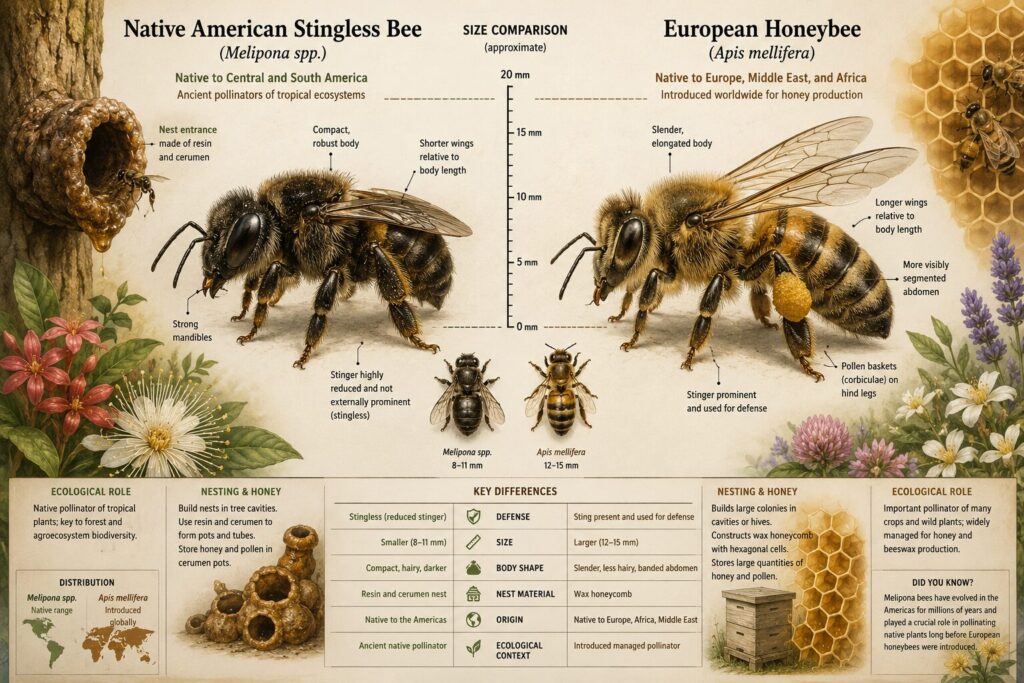
Begin with a fact almost no one knows: there are no stinging honeybees native to the Americas. The indigenous bees of this continent are stingless, with over 400 species belonging to the tribe Meliponini, found from Mexico to Argentina.
They cannot sting. They bite weakly in defense. They were the primary pollinators of the western hemisphere for millennia, farmed as sacred animals by the Maya, whose honey trade predated European contact by centuries.
The European honeybee — Apis mellifera — arrived with colonists around 1622. It is not native. It is not endangered. There are more managed honeybees on Earth today than at any point in human history. The bees facing extinction are the stingless native bees, quietly outcompeted by the sheer foraging volume of imported European colonies that industrial agriculture has deployed at massive scale and then, frequently, allowed to swarm and go feral.
And then there is the second bee, the one the Government of Canada ranks as the second most dangerous insect on the continent, between the brown recluse and the black widow spider.
Africanized Honeybee — “Killer Bee”
Man-made hybrid. Escaped a Brazilian quarantine facility in 1957. Attacks in swarms up to 10× larger than European bees. Pursues targets 400+ meters. Has killed approximately 1,000 people across the Americas. Not native to this continent.
The Africanized honeybee, commonly called the killer bee, is not a naturally occurring species. In 1956, Brazilian geneticist Dr. Warwick Kerr imported African honeybees to crossbreed with European bees, seeking a more productive tropical honey producer. In 1957, 26 swarms escaped a quarantine facility near São Paulo. No regulatory body stopped them. No industry paid for the consequences.
The hybrid spread north at 100 to 200 miles per year. It reached Texas in 1990, California in 1995, and is now established across the American Southwest, moving steadily northward. Its venom is no more potent than a European bee’s. The danger is volume and aggression. A disturbed Africanized swarm can deliver thousands of stings in minutes, causing acute respiratory failure, kidney failure, and anaphylactic shock. It has killed farmworkers, landscapers, elderly residents in wheelchairs, and people operating farm equipment. It does not stop when you run.
“You can’t believe how bad they are,” said the pest control operator called in after an Africanized swarm killed an Arizona landscaper — stung by over 50,000 bees nesting in two 300-pound hives that had grown visibly on a residential roofline for over a year before anyone was warned.
Part II For Risk & Emergency Managers
A Foreseeable Mass Casualty Vector with No Regulatory Framework
From a risk management perspective, the feral Africanized honeybee situation has the signature of a predictable, preventable, and systematically ignored hazard. The threat profile is well-documented. The casualty mechanism is understood. The geographic spread is tracked. And yet there is almost no regulatory framework governing the duty of industrial agricultural operations to manage feral swarms originating from their hives.
Compare this to an industrial chemical spill. If a farm operation were storing a chemical substance that routinely escaped containment, spread across property lines, killed workers and bystanders, and destroyed native ecosystems over a multi-decade arc, the regulatory and legal response would be overwhelming. The vector here is biological rather than chemical. The outcome is functionally identical.
A single managed European honeybee hive can contain 50,000 to 80,000 foragers. Industrial farms routinely deploy hundreds of hives for pollination services. When those hives swarm, a natural reproductive behavior that commercial operations frequently fail to manage, they establish feral colonies in woodpiles, wall cavities, abandoned equipment, cement blocks, and eaves. Those colonies grow undisturbed. They are not on any registry. No authority is notified. No neighbor is warned. When a landscaper, farmworker, or child disturbs one, the response is measured in emergency room admissions and obituaries.
Emergency managers should also note: Africanized bee swarm events are extremely difficult to manage on scene. Responders without specialized protective equipment cannot safely approach an active swarm. Standard fire suppression techniques are largely ineffective. First responders have been stung attempting rescue — including the firefighters in the 2008 California case where a wheelchair-bound man was killed while emergency services waited for mutual aid that arrived too late.
The ecological dimension compounds the emergency management picture. As native stingless bee populations are displaced by feral European and Africanized colonies, the agricultural pollination dependencies that entire supply chains rest on become increasingly fragile. This is not a distant theoretical risk. It is an ongoing ecological disruption with direct food security implications — the kind of slow-moving, cumulative crisis that emergency managers are trained to recognize and that policymakers consistently fail to act on until after the acute event.
Part III For Plaintiff’s Attorneys
The Legal Theory: What Exists, What’s Missing, and Why That’s the Opportunity
Legal research confirms what this analysis suspected: there is no recognized feral honeybee mass tort. No major coordinated MDL docket. Individual wrongful death and premises liability cases exist and have produced verdicts, but no plaintiff’s firm has assembled them into a coherent theory of systemic corporate negligence.
That is not a weakness of the theory. It is the condition the theory is in before someone builds it. Asbestos litigation was episodic individual cases through the 1960s. Tobacco was dismissed as unwinnable through the 1980s. The transformation from individual case to mass tort did not happen because the harm changed. It happened because someone finally aggregated the cases, funded the science, and constructed a repeatable causation theory against identifiable defendants with resources.
The existing case law provides a foundation. Courts have already established that bees are the operative cause of resulting damage — the South Carolina Court of Appeals held in SC Farm Bureau v. Berlin (2002) that honey damage from a hive was “caused by” the bees, supporting the causal chain. Wrongful death verdicts exist. Gross negligence has been pleaded and survived. The liability framework is being built one case at a time by individual plaintiff’s attorneys who do not know they are working on the same case.
Existing Case Record — Selected Incidents
Tucson, AZ
Pima County Superior Court
Landscaper Daniel Martinez, 48, stung to death by Africanized bees nesting in two 300-pound hives — approximately 100,000 bees — on a homeowner’s roofline. Hives had been visible and growing for over a year. No warning given to workers.
→ Wrongful death + gross negligence filed. Punitive damages sought. Reckless misconduct alleged.
Texas
Wilhelm v. Flores
Farm worker died of anaphylactic shock from bee stings. Jury returned actual damages of $1,591,000 and punitive damages of $75,000. Case addressed duty of care owed by bee sellers to downstream workers — establishing that duty of care questions around bee-related death are justiciable and jury-triable.
→ Verdict for plaintiff. Liability framework is judicially recognized.
Imperial County, CA
Niland Fire District Case
Wheelchair-bound man killed by Africanized swarm. Firefighters stung attempting rescue. Mutual aid arrived too late. Court dismissed suit against fire district — but the source of the feral hive was never identified, never traced, never held accountable.
→ Original source of hive: unidentified. No corporate defendant ever named.
Waco, TX
Multiple incidents
At least 8 people killed by Africanized bees in Texas since 1990. Each treated as an isolated incident. No investigation into whether feral colonies originated from commercial agricultural operations. No aggregation of plaintiff class.
→ Cases never connected. No coordinated discovery ever conducted.
The Causation Bridge: Bee Population Genetics
The primary legal obstacle identified by existing case research is what courts call the “diffuse source” problem. With chemical contamination, you trace the chemical to a pipe. With feral bees, individual colonies, nesting locations, land use patterns, and incident circumstances vary significantly from case to case — making it difficult to establish common exposure against a common defendant.
This obstacle is solvable. The science already exists. It simply has not been applied in litigation yet.
The Missing Bridge: Bee Population Genetics 🧬
Honeybee population genetics, specifically mitochondrial DNA analysis and microsatellite marker profiling, allows researchers to trace a feral swarm’s genetic lineage back to a managed colony of origin. This methodology has been used extensively in ecological research to map the spread of Africanized bee hybridization across geographic regions. It has not yet been applied in litigation to connect a specific attack swarm to a specific commercial operation’s mismanaged hive. The firm that funds this science in a wrongful death case will own the causation bridge that transforms episodic individual cases into a coherent mass tort plaintiff class. This is the exact scientific inflection point that asbestos litigation reached in the early 1970s — the moment when individual cases became a coordinated theory.
The Four Elements – Present and Traceable
Mass Tort Threshold Requirements
→ Common exposure / common defect. Industrial agricultural operations deploying managed hives at scale, failing to prevent swarming, and allowing feral colonies to establish constitute the common negligent practice. The Africanized bee has a uniquely clean single-origin causation story — one laboratory, one escape event, one identifiable year — that partially solves the diffuse source problem at the species level before individual hive tracing even begins.
→ Numerous injured claimants. Wrongful death and serious injury cases from Africanized bee attacks span multiple states and three decades. Farmworkers, landscapers, rural residents, and outdoor workers form a coherent plaintiff class. The cases exist. They have simply never been aggregated.
→ Repeatable causation theory. Bee population genetics provides the scientific mechanism to connect attack swarms to managed hive sources. Courts have already established that bees are the operative cause of resulting damage. Wrongful death verdicts have been returned. The remaining step is coordinated discovery and genetic sourcing.
→ Identifiable defendants with resources. Industrial agriculture is a multi-trillion dollar industry. Commercial beekeeping operations that supply hives to farms are insured, incorporated, and identifiable. Critically: there is almost no regulatory compliance framework governing feral swarm management. Defendants cannot claim they followed the rules. There are no rules. That absence is the negligence.
The ecological destruction of native pollinator populations adds a second tier of liability — public nuisance and agricultural contamination claims, brought by state attorneys general, environmental organizations, and farmers whose crop yields have declined as native pollinator populations were displaced. This is how tobacco and lead paint litigation scaled. Personal injury cases provide the jury-compelling human narrative. Public nuisance provides the institutional plaintiff class with the resources to sustain multi-year litigation.
This is not a mass tort yet. That is exactly why you should bee in the room when it becomes one. 🐝
The thesis of this analysis
Building this litigation from the ground up is 2 to 3 years of foundational work: identifying a strong wrongful death plaintiff with a traceable commercial hive source, commissioning bee genetics research to establish causation methodology, developing the regulatory failure narrative for the liability brief, and finding co-counsel across affected states to build the plaintiff class.
That is exactly where asbestos litigation was in 1972. The firms that did that groundwork collected the largest verdicts in American legal history a decade later.
The bees are already there. The deaths are already happening. The science that connects them to accountable defendants already exists. The only thing missing is a firm willing to be first.
LJ Learn
For informational and educational purposes only. Not legal advice. The author is an educator, risk manager, and emergency manager — not an attorney.
Thanks for Reading!
Looking for more insights, exclusive offers, and expert tips? Stay connected with the LJ Learn newsletter! Join our community of curious minds and passionate learners to continue your lifelong learning journey.