Texas Rules of Civil Procedure: A Plain-English Primer for Pro Se Litigants
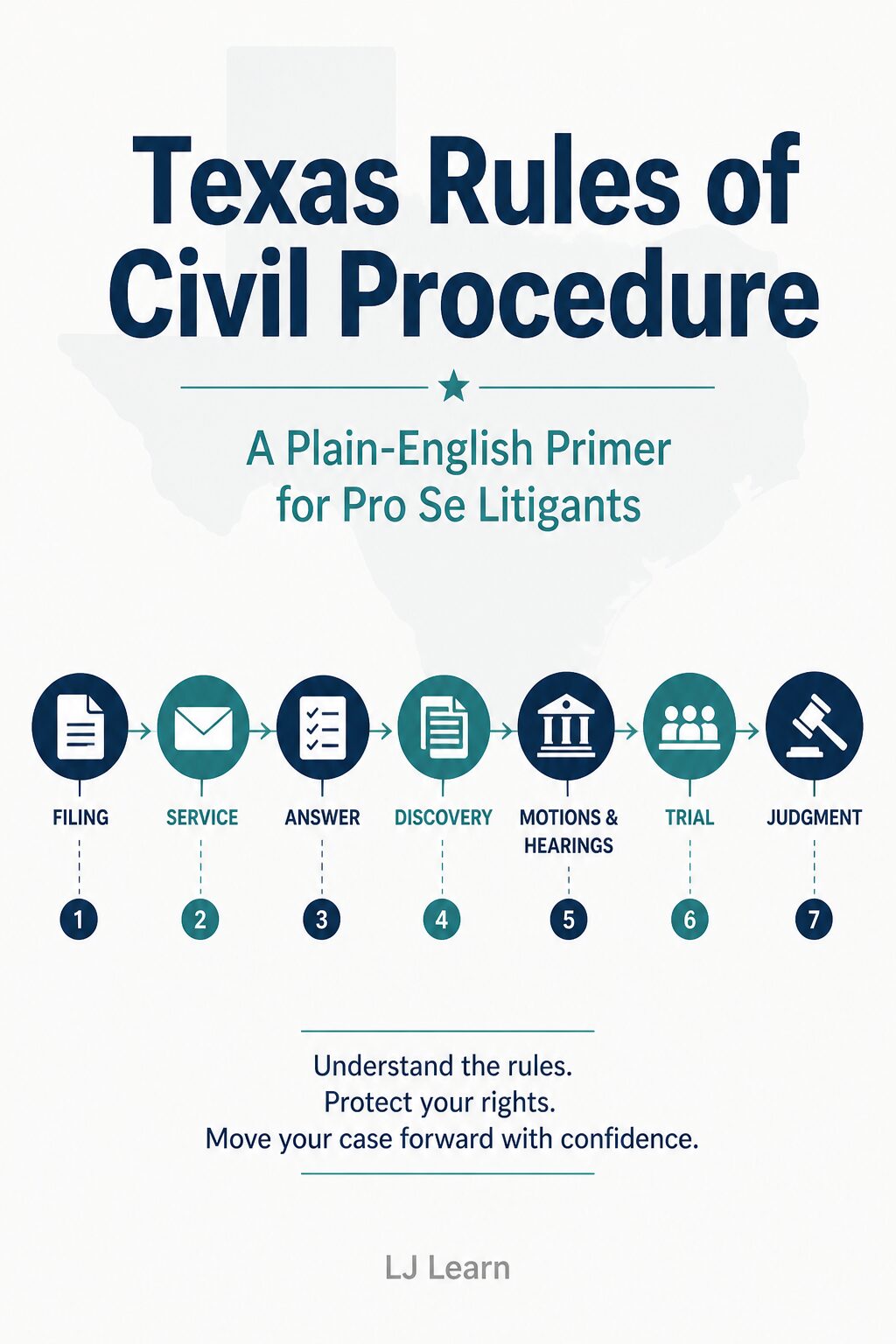
If you are representing yourself in a Texas civil case, the Texas Rules of Civil Procedure will govern almost every important step. The rules can be technical, but the basic idea is simple: they tell you how a case starts, how the other side must be notified, how responses are filed, how evidence is exchanged, and how a case is resolved.
NOTICE: This primer is for general orientation only. It is not legal advice, and it does not replace the Texas Rules of Civil Procedure, local rules, or a lawyer’s guidance. You should always consult with a lawyer on legal matters.
What the Texas Rules of Civil Procedure are
The Texas Rules of Civil Procedure are the rules that control civil cases in Texas state courts. In Texas justice courts, there are also special rules in Part V of the Texas Rules of Civil Procedure that are designed for the simplified procedures used in those courts.
Justice-court cases include small claims, eviction cases, debt claim cases, and repair and remedy suits. Those cases are often where self-represented litigants appear, so it is especially important to understand that the rules still apply even when the courtroom is less formal.
Why the rules matter
Procedural rules are not just technicalities. They determine whether:
– your lawsuit is properly filed,
– the other side was properly served,
– your answer was timely,
– the court can enter a default judgment,
– discovery is available,
– motions are heard,
– and the case can proceed to trial.
Missing a deadline or failing to follow the required steps can cause real harm. In some situations, it can mean losing by default even if you may have a defense.
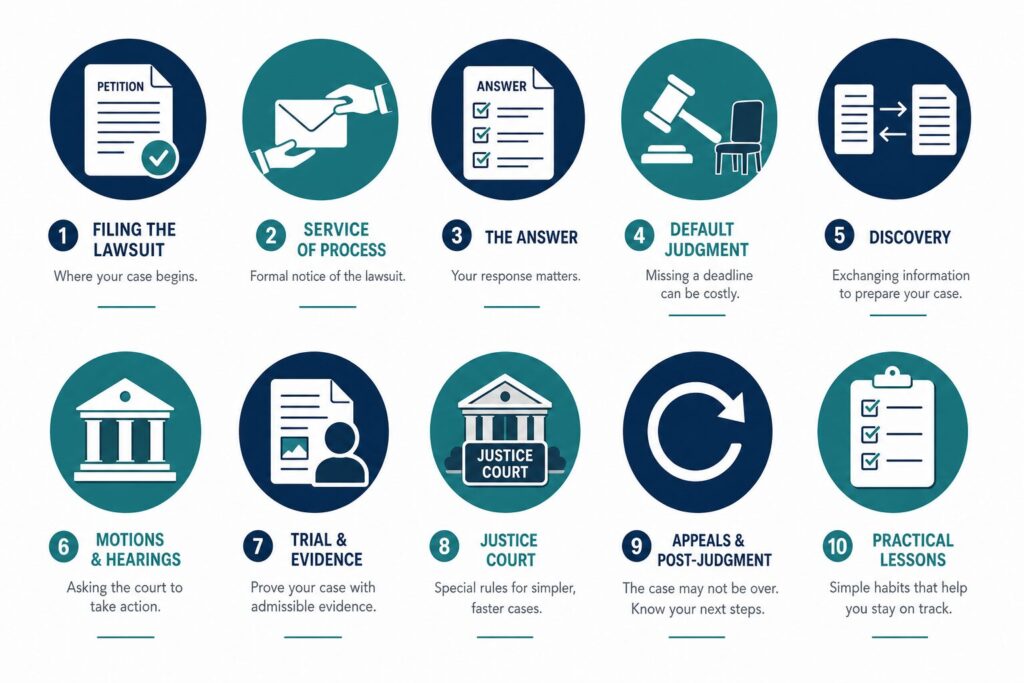
The basic life cycle of a Texas civil case
Most civil cases follow the same general path:
1. A petition is filed
2. Citation and petition are served
3. The defendant files an answer or motion
4. The parties exchange information
5. The court hears motions or sets trial
6. A judgment is entered
7. Post-judgment deadlines and appeal rights begin
That sequence sounds straightforward, but each stage has its own rules.
1. Filing the lawsuit
A civil case usually begins when the plaintiff files a petition. In Texas justice courts, the petition must provide enough information to tell the defendant what the claim is about and what relief is being requested.
For pro se litigants, the main point is this: do not assume that a handwritten complaint or a short statement is enough unless it satisfies the rules for the court where you are filing. The court and clerk may provide forms, but the filing still has to be completed correctly.
Common filing issues
– Naming the wrong defendant
– Asking for relief the court cannot grant
– Failing to state enough facts
– Filing in the wrong court
– Forgetting required attachments or fees
2. Service of process
A case does not properly move forward until the defendant is served with notice of the lawsuit. Service is a formal process that gives the defendant a copy of the lawsuit papers and tells the defendant what must be done next.
In justice court, the rules define citation as the court-prepared document that informs a party that they have been sued. The citation is served with the petition, and the papers must be delivered in the manner the rules require.
Proper service matters because a court generally cannot impose liability without giving the defendant legally sufficient notice and an opportunity to respond.
What a defendant should look for
– The name of the court
– The case number
– The date by which an answer is due
– The identity of the plaintiff
– The claim being asserted
Common service problems
– Service on the wrong person
– Missing papers
– Incorrect address
– Improper return of service
– Wrong deadline information on the citation
If service is defective, that can affect the validity of a default judgment and may provide grounds to challenge the judgment later.
3. The answer: how a defendant responds
After being served, the defendant must respond by filing an answer. In justice-court practice, an answer is the defendant’s written response to the lawsuit.
The answer deadline is critical. If the defendant does not answer on time, the plaintiff may ask for a default judgment. A default judgment can be entered because the defendant failed to appear or respond, not necessarily because the plaintiff proved every allegation at a contested hearing.
What an answer can do
An answer may:
– deny the allegations,
– raise defenses,
– object to defects in the lawsuit,
– and preserve the defendant’s right to be heard.
In some Texas courts, a general denial may be enough to contest the plaintiff’s claims, but litigants should check the rules for the specific court and case type.
Common answer mistakes
– Filing too late
– Failing to sign the answer
– Filing in the wrong court
– Assuming a phone call or informal discussion counts as an answer
– Ignoring a citation because the claim seems minor
4. Default judgment
If the defendant does not answer in time, the plaintiff may seek a default judgment. That does not always mean the plaintiff automatically wins every issue, but it can mean the court accepts the plaintiff’s claim without the defendant’s participation.
For pro se litigants, this is one of the most important parts of civil procedure. A missed answer deadline can be case-ending.
Why default judgment matters
A default judgment can:
– create a money judgment,
– lead to collection efforts,
– affect credit,
– and limit later defenses.
If you were served but missed the deadline, act immediately. In many situations, prompt action is necessary to ask the court to set aside the default or otherwise obtain relief.
5. Discovery: exchanging information
Discovery is the process by which parties obtain information from one another to prepare for trial or enforce a judgment. Discovery is often where civil cases become more serious and more technical.
Depending on the court and the type of case, discovery can include:
– requests for documents,
– requests for admissions,
– interrogatories,
– depositions,
– and requests for inspection.
The key point for pro se litigants is that discovery has deadlines and formal requirements. Ignoring discovery requests can lead to sanctions or the loss of evidence.
Practical discovery tips
– Read every request carefully.
– Calendar the response deadline immediately.
– Respond in writing.
– Object only when you have a real basis to object.
– Preserve relevant documents and electronic communications.
6. Motions and hearings
A motion is a written request asking the judge to take some action. Motions can address many issues, including dismissal, discovery disputes, continuances, or summary judgment.
A hearing may be required before the court rules. In some cases, a written response is also required by a certain deadline. If you receive a motion and do nothing, the court may grant it.
Common motion problems for pro se litigants
– Missing the response deadline
– Not attaching evidence
– Failing to serve the other side
– Not understanding whether a hearing is required
– Assuming the judge will search the record for your arguments
The judge generally decides only the issues properly presented. The court is not responsible for building your case for you.
7. Trial and evidence
At trial, the court decides the disputed facts. The exact procedure depends on whether the case is in justice court, county court, district court, or another court.
Even in simpler courts, parties usually must:
– present admissible evidence,
– call witnesses properly,
– and follow the court’s instructions.
A common mistake is assuming that telling the judge your side of the story is enough. You usually need evidence, not just explanation.
Useful trial preparation steps
– Organize documents in order
– Make copies for the court and the other side
– Prepare a short list of key facts
– Know what you need to prove
– Bring witnesses if necessary
– Arrive early
Special issues in justice court
Justice court is where many pro se litigants appear, and the rules are simplified compared to district court. But simplified does not mean informal in the sense of “anything goes.” The justice-court rules still have structure and deadlines.
Justice-court rules cover:
– filing,
– service,
– answers,
– default judgments,
– setting hearings,
– discovery limits,
– and appeals.
If your case is in justice court, make sure you are reading the special justice-court rules, not just the general rules for district court litigation.
Appeals and post-judgment steps
Once the court signs a judgment, the case is not necessarily over. There may be post-judgment motions, deadlines to request relief, and deadlines to appeal.
These deadlines can be short. If you think the judgment is wrong, do not wait. Read the judgment immediately and figure out what deadline applies.
Post-judgment concerns
– Motion for new trial
– Motion to set aside default
– Appeal deadline
– Enforcement of judgment
– Writs and collection activity
Practical lessons for pro se litigants
The most important advice is often the simplest:
– Read every paper immediately
– Calendar every deadline
– File in the correct court
– Serve the other side correctly
– Keep copies of everything
– Bring evidence, not just arguments
– Do not ignore court notices
– Ask for legal help early if possible
A useful rule of thumb
If a document from the court or the other party tells you to do something by a certain date, treat that date as serious and act early. Do not wait until the last day.
Common misconceptions
“If I’m pro se, the rules are relaxed.”
Not really. Courts may be patient with questions, but pro se litigants are generally still expected to follow the procedural rules.
“If I explain my side clearly, I’ll be fine.”
Not necessarily. Civil cases often turn on evidence, deadlines, and proper procedure.
“If the other side is wrong, I do not need to respond.”
That is a dangerous assumption. If you do not answer or appear, the court may enter default relief.
“The clerk can tell me what to file.”
Clerks can provide procedural information, but they cannot act as your lawyer or give legal advice.
Texas civil procedure can feel intimidating, especially for someone handling a case alone. But the system becomes easier to understand if you focus on the core sequence: filing, service, answer, discovery, motions, trial, judgment, and appeal. If you keep track of deadlines, follow the rules for your court, and respond promptly to papers you receive, you will avoid many of the most common and costly mistakes.
Thanks for Reading!
Looking for more insights, exclusive offers, and expert tips? Stay connected with the LJ Learn newsletter! Join our community of curious minds and passionate learners to continue your lifelong learning journey.