Emotional Intelligence: The Life-Changing Skill We’re All Overlooking
You know the feeling: talking to someone who just doesn’t get it, watching connection slip through your fingers. Maybe it’s your coworker brushing off your ideas, or your partner shutting down when things get tense. You leave the interaction drained, wondering why some people seem wired to connect effortlessly, while others make you want to scream into a pillow.
But it’s not just them. It’s us. Or rather, something most of us were never taught: how to understand emotions, ours and theirs, and respond in a way that builds connection instead of friction.
Emotional intelligence has quietly become the missing piece in relationships, workplaces, and even society at large. The term might sound like self-help fluff, but its impact is anything but. Daniel Goleman, author of the bestseller Emotional Intelligence, called it the critical factor that sets high achievers apart, arguing that what really matters for success, character, happiness, and lifelong achievement is a definite set of emotional skills. And yet, while we obsess over IQ, resumes, and certifications, this is the skill set that could actually change our lives, and it remains almost entirely overlooked.
Here’s why it’s so hard to access in the moment. When someone dismisses your idea or shuts down on you, your body reacts before your brain has a chance to weigh in. Your heart rate spikes, stress hormones flood your system, and the part of your brain responsible for careful thought temporarily takes a back seat to the part built for fight or flight.
Therapist Samantha Lubin (Binstock), LPC at Post Oak Family Wellness, sees this constantly in her work with clients.
“People come in thinking they have an anger problem or a communication problem,” she says, “when really they have a nervous system that’s doing exactly what it’s supposed to do. The work isn’t getting rid of the reaction. It’s learning what to do in the gap right after it.”
The tool Samantha reaches for most often with clients, and in her own life, comes from Dialectical Behavior Therapy (DBT), a framework developed by psychologist Marsha Linehan. It’s called the STOP skill, part of DBT’s distress tolerance module alongside tools like TIP and ACCEPTS, and it draws on DBT’s broader concept of Wise Mind, the idea that we can act from a grounded place rather than pure emotion or pure logic.
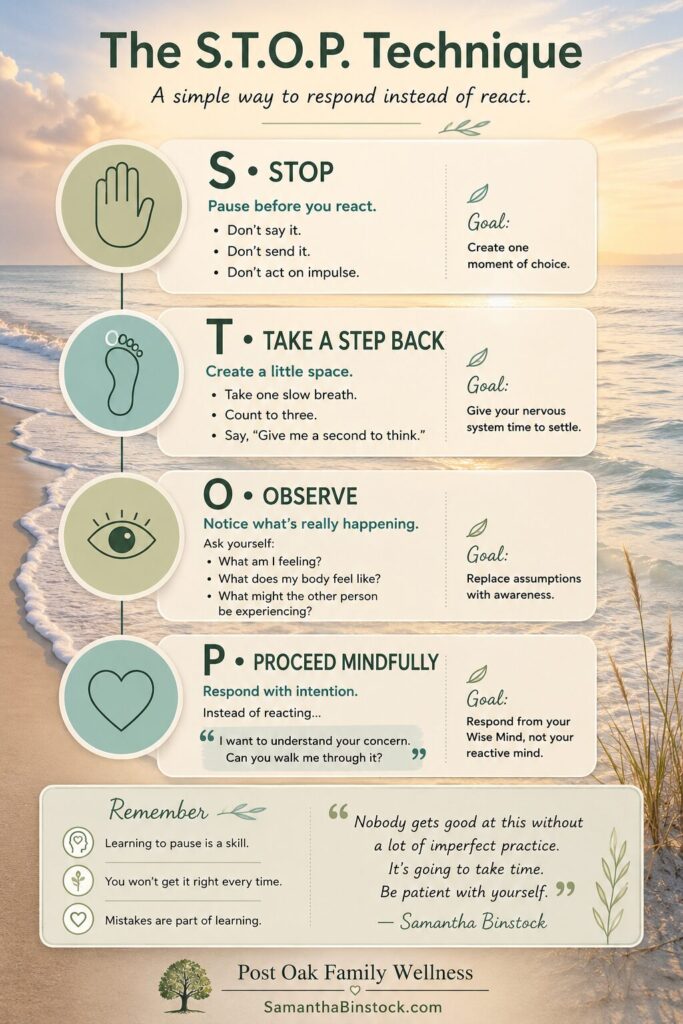
STOP stands for Stop, Take a step back, Observe, and Proceed mindfully. It was built specifically to interrupt impulsive reactions in moments of acute emotional distress, which makes it exactly the tool for that heat-rising, face-flushing moment.
“I use it almost every day,” Samantha says. “Everyone who experiences emotional dysregulation needs to know this.”
History offers its own example of what this can look like in practice, decades before it had a clinical name. Abraham Lincoln was famed for his wisdom and restraint, and one of his habits shows why. When he was furious with someone, he’d write them a scathing letter, get every bit of anger out on the page, and then tuck it away unsent. He never mailed a single one.
“That’s not suppression, that’s emotional regulation,” Samantha explains. “He let himself feel the anger fully. He just didn’t let it drive the car.”
Lincoln’s unsent letters remind us that emotions aren’t the enemy. Unmanaged emotions are. So why are we still fumbling with something so fundamental?
Emotional intelligence isn’t just about managing anger or avoiding conflict. It’s self-awareness, empathy, and communication, and unlike IQ, these are skills you build with practice and repetition, not a talent you either have or don’t. Most of us just never got a roadmap for how. And the world shows the cracks. Miscommunication at work, strained relationships, rising mental health struggles: these are all signs we need this now more than ever.
Let’s go back to that coworker who brushed off your idea, and walk through what STOP actually looks like in that moment.
S is for Stop. Literally freeze. Don’t say the thing that’s loaded on the tip of your tongue, don’t send the email, don’t react. Just stop moving forward for one second. That helps you by making you think before you speak.
T is for Take a step back. Create physical or mental distance. That might mean an actual breath before you speak, or a beat of silence, or saying “give me a second to think about that” out loud instead of firing back.
“People think this step is about being polite,” Samantha says. “It’s really about giving your body time to come back down so the person who responds next is actually you, not the surge.”
O is for Observe. Notice what’s happening, in your body, in your thoughts, in the room. What are you feeling, specifically? Not just “mad,” but dismissed, embarrassed, unseen. What’s the other person’s state likely to be? Are they stressed about a deadline, defensive about something your idea threatened, having a bad day that has nothing to do with you?
“Naming the exact feeling, not just the general one, actually re-engages the thinking part of the brain,” Samantha notes. “It changes what’s happening physiologically.”
P is for Proceed mindfully. Now, and only now, respond, from that grounded Wise Mind place rather than the reactive one. Instead of “wow, okay, noted,” which quietly erodes a relationship every time, you might say, “I want to understand your concern, can you walk me through it?” That single sentence does two things at once: it gives your own nervous system something constructive to do, and it signals to the other person that you’re engaging rather than retreating or attacking.
This is not easy, and it will not feel natural at first. You will mess it up. You’ll snap at someone, or replay a conversation later and think of the better thing you should have said.
“That’s not a sign you’re bad at this,” Samantha says. “That’s the process. Nobody gets good at this without a lot of practice that didn’t go well first. It’s going to take time, be patient with yourself.”
A few resources make the reps easier.
The DBT Tools website is a solid place to see STOP alongside the rest of the distress tolerance skill set in more depth. For self-awareness, journaling apps built for mood tracking can help you spot your own patterns, what tends to trigger you, and how long your surges typically last. For empathy specifically, Brené Brown’s Dare to Lead and Helen Riess’s The Empathy Effect both go deeper into building it as a practiced skill. And for a fuller framework beyond what’s here, Emotional Intelligence 2.0 by Travis Bradberry and Jean Greaves is a strong next read.
Now imagine a world where we all mastered these skills. Leaders would lead with compassion. Families would thrive on understanding. And instead of feeling stuck in endless conflict, you’d have the tools to turn those moments into growth.
That’s what we’re building at LJ Learn, a space where emotional intelligence is more than a buzzword. It’s a skill you can learn, practice, and apply every day.
Let’s start your journey together. Subscribe to our newsletter at LJ Learn, explore our resources directory, and join the conversation in our Facebook group, the Knowledge Exchange.
What’s one way emotional intelligence has changed your life? Or what do you struggle with most? Let us know in the comments, we’re all learning here.
Samantha Binstock (Lubin). M.A., M.Ed, CDA is an Licensed Professional Counselor (LPC) in Houston, Texas. Her website is SamanthaBinstock.com
Thanks for Reading!
Looking for more insights, exclusive offers, and expert tips? Stay connected with the LJ Learn newsletter! Join our community of curious minds and passionate learners to continue your lifelong learning journey.