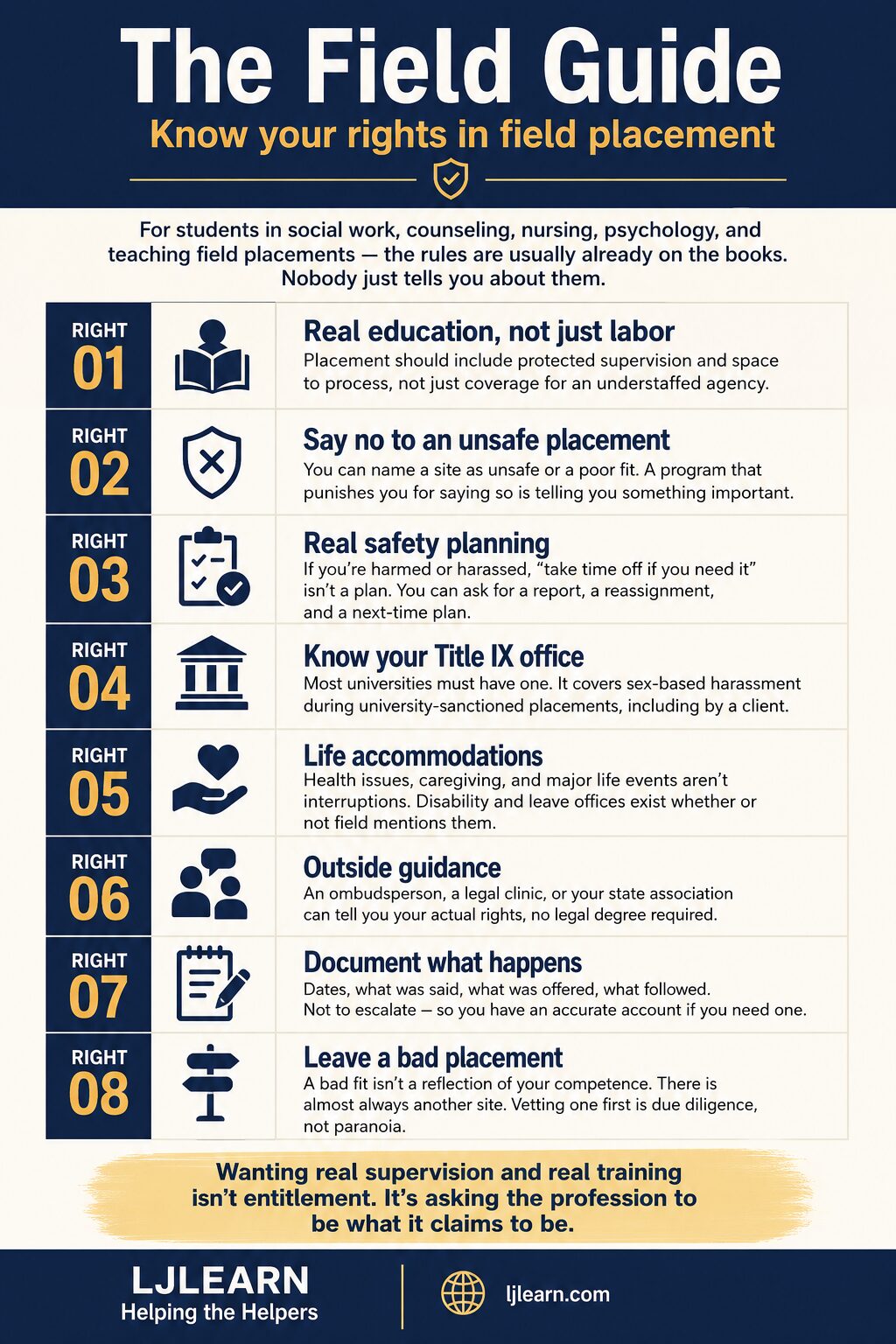
The Field Guide: Know your rights in helping-profession field placements
Summary
Most of the rules protecting field placement students already exist. Nobody tells you about them. The Field Guide does.
Why this exists
Social work, counseling, nursing, psychology, and teaching all require supervised hours before licensure. Most of what trainees learn about their actual rights during those hours comes from rumor, fear, or bad experience, not from anyone telling them plainly what protections already exist. This guide exists to close that gap.
This guide is part of LJLearn’s Helping the Helpers initiative, which looks at why field placement so often functions as unpaid staffing instead of education. If you want the fuller picture, start there.
You have the right to real education, not just labor
Field placement is supposed to include protected supervision, time to process difficult experiences, and support that doesn’t feel like surveillance. If a placement is functioning as staffing coverage with no real teaching happening, that’s worth naming, to yourself first, and eventually to your program.
You have the right to say no to an unsafe or inappropriate placement
If a site feels unsafe, poorly supervised, or inappropriate for your training level, you can raise that. A program that punishes you for raising it is telling you something important about how it handles harm.
You have the right to safety planning, not just sympathy
If you’re harassed, threatened, or harmed by a client, “take some time off if you need it” is not a safety plan. A real response includes a documented incident report, a change in your assignment or contact with that client, and a conversation about what happens if it happens again. You’re allowed to ask for all three.
You have the right to know about Title IX
Most universities are required to have a Title IX office, which handles sex-based harassment and assault, including incidents that happen during university-sanctioned placements. This applies even when the harasser is a client rather than a fellow student or staff member. You can search “[your school] Title IX office” or “[your school] Title IX coordinator” to find contact information.
You have the right to disability and life accommodations
Health issues, caregiving responsibilities, and major life events are not “interruptions to the field machine.” Most universities have an office handling disability accommodations, and most programs have some process for medical or family leave. These offices exist whether or not your field instructor mentions them.
You have the right to grievance and appeal processes
If a placement, supervisor, or attendance decision feels unfair, there is almost always a formal way to challenge it, through a field director, a department ombudsperson, or a university grievance office. Learning your program’s actual written policy, not the version other students fear is true, is worth an afternoon of reading.
You have the right to outside guidance
You don’t need to figure this out alone or become a legal expert. A student ombudsperson, a law school’s free legal clinic, your university’s Title IX office, or your state’s professional association (NASW for social work, for example) can tell you plainly what your actual rights are, before you assume your field instructor’s version of the rules is the only version.
You have the right to document what happens to you
Keep a simple, dated record of anything involving safety or unfair treatment, what happened, who was present, what was said, what was offered, what followed. Not to escalate, but so you have an accurate account if you ever need one. Memory fades under stress. A contemporaneous record doesn’t.
You have the right to leave a bad placement
Agencies and supervisors vary widely, and a bad fit is not a reflection of your competence. There is almost always another site. Vetting a placement, asking alumni what it’s really like, is not paranoia. It’s due diligence for your own life and labor.
A closing word: Wanting real supervision, real safety planning, and real education isn’t entitlement. It’s asking the profession to be what it claims to be. If you’re seeing the gaps clearly, even early in your training, that clarity will make you better at this work than any culture of quiet endurance ever could.
Thanks for Reading!
Looking for more insights, exclusive offers, and expert tips? Stay connected with the LJ Learn newsletter! Join our community of curious minds and passionate learners to continue your lifelong learning journey.